

How to Create a Winning Small Business Website Plan: A Step-by-Step Guide

Does the thought of creating a website for your business feel completely overwhelming? If you’re wondering where to even begin, you are not alone. The fear of choosing the wrong platform, wasting precious time and money, or ending up with a site that doesn’t truly feel like you can be paralyzing. But the path to a beautiful, effective website doesn’t start with code or design templates; it begins with a clear and thoughtful small business website plan.
Think of this guide as a warm conversation, your creative partner on this journey. Together, we’ll gently walk through the essential steps to define what you truly need your website to do. We will co-create an actionable roadmap that captures the essence of your brand, allowing you to move forward with confidence instead of confusion. By the end, you’ll feel empowered to bring an online home to life that not only looks stunning but also attracts your ideal clients and supports your biggest goals.
Key Takeaways
- Start by clarifying your website’s core purpose and who you want to connect with. This foundational step makes every other decision easier and more meaningful.
- Discover how to intentionally map your site’s structure and visual vibe to ensure your website not only looks beautiful but truly feels like you.
- Demystify the technical essentials like platforms and hosting. Making these choices early on prevents future headaches and keeps your project flowing smoothly.
- A truly effective small business website plan extends beyond launch day. Learn how to prepare for a seamless launch and create a simple strategy for long-term success.
Step 1: Define Your Foundation – Goals, Audience, and Success
Before we dream up beautiful designs or write a single line of code, let’s pause and connect with the heart of your business. The most effective small business website plan begins not with the ‘what’ or the ‘how,’ but with the ‘why.’ When you build this strong foundation first, every other decision in your website journey becomes clearer, easier, and more aligned with your vision.
Think of this step as co-creating the blueprint for your online home. It’s about ensuring that your digital presence is an authentic and powerful reflection of your core business, built with intention from the very start.
Clarifying Your Website’s Primary Goal
What is the single most important action you want a visitor to take when they land on your site? This is your North Star. While your website can certainly support secondary goals, focusing on one primary purpose brings incredible clarity to the entire creative process. This core goal will shape your site’s structure, content, and flow.
Your primary goal might be to encourage visitors to:
- Book a discovery call with you
- Purchase a product from your online shop
- Join your heartfelt email newsletter
Understanding Your Ideal Client
Now, let’s picture the one person you are truly meant to serve. Who are they? Move beyond simple demographics and try to understand their world. What are their biggest challenges or deepest desires? How does your unique gift solve their problem? When you can speak directly to that one person-as if you’re having a warm conversation over coffee-your website becomes a welcoming space where they feel truly seen, heard, and understood.
How Will You Measure Success?
How will you know that your beautiful new website is truly working for you? Defining success isn’t about overwhelming data; it’s about setting simple, meaningful goals that align with your vision. This is a fundamental piece of effective online presence management, helping you understand what truly connects with your audience. For you, success might look like “five new contact form submissions per month.” By defining this early, you create a clear way to track your progress and make intuitive, thoughtful improvements over time.
Step 2: Map Your Content & Structure – What Your Site Will Say and Do
Once we know why your website exists, our next step on this journey is to map out what it will say and do. Think of this as co-creating the blueprint for your digital home. Your website’s structure is its floor plan-the navigation and flow that guide visitors from one room to the next. The content is the heart and soul within those rooms, sharing your story and connecting with your ideal clients.
This is the beautiful stage where your abstract goals become a tangible sitemap. It’s a vital part of your small business website plan that ensures every page has a purpose and every visitor feels welcomed and understood, never lost or confused.
Outlining Your Essential Pages
Let’s start by sketching out the main pages. Most small businesses need a core set to tell their story effectively. This simple structure, often called a sitemap, acts like a family tree for your pages, ensuring the journey for your visitors feels logical and intuitive. Consider starting with:
- Home: Your welcoming front door.
- About: The story of you and your “why.”
- Services/Offerings: What you do and for whom.
- Contact: How people can connect with you.
- Blog, Portfolio, or Testimonials: Pages that build trust and showcase your unique essence.
Gathering Your Core Message and Content
Now, we begin to gather the raw materials that will fill your pages. Don’t aim for perfection yet; just collect. Jot down a one-sentence summary of what you do for each service you offer. For example, a niche business in another market might focus entirely on offering a test baterije električnega vozila (electric vehicle battery test). Gather your favorite testimonials, photos, and any text you’ve already written. This foundational step of content gathering is a core part of many expert guides on how to make a small business website, as it ensures your site has substance from day one. Think about headlines that speak directly to your ideal client’s needs and dreams.
Planning Your Calls to Action (CTAs)
Every page should gently guide your visitor toward the next step. This is your Call to Action (CTA). Your main CTA should align with the primary goal we defined in step one. Instead of a vague “Click Here,” we’ll use warm, clear, and action-oriented language like “Schedule a Free Call” or “Download Your Guide.” A thoughtful small business website plan includes deciding where these supportive invitations will be placed on each page to feel natural and helpful.
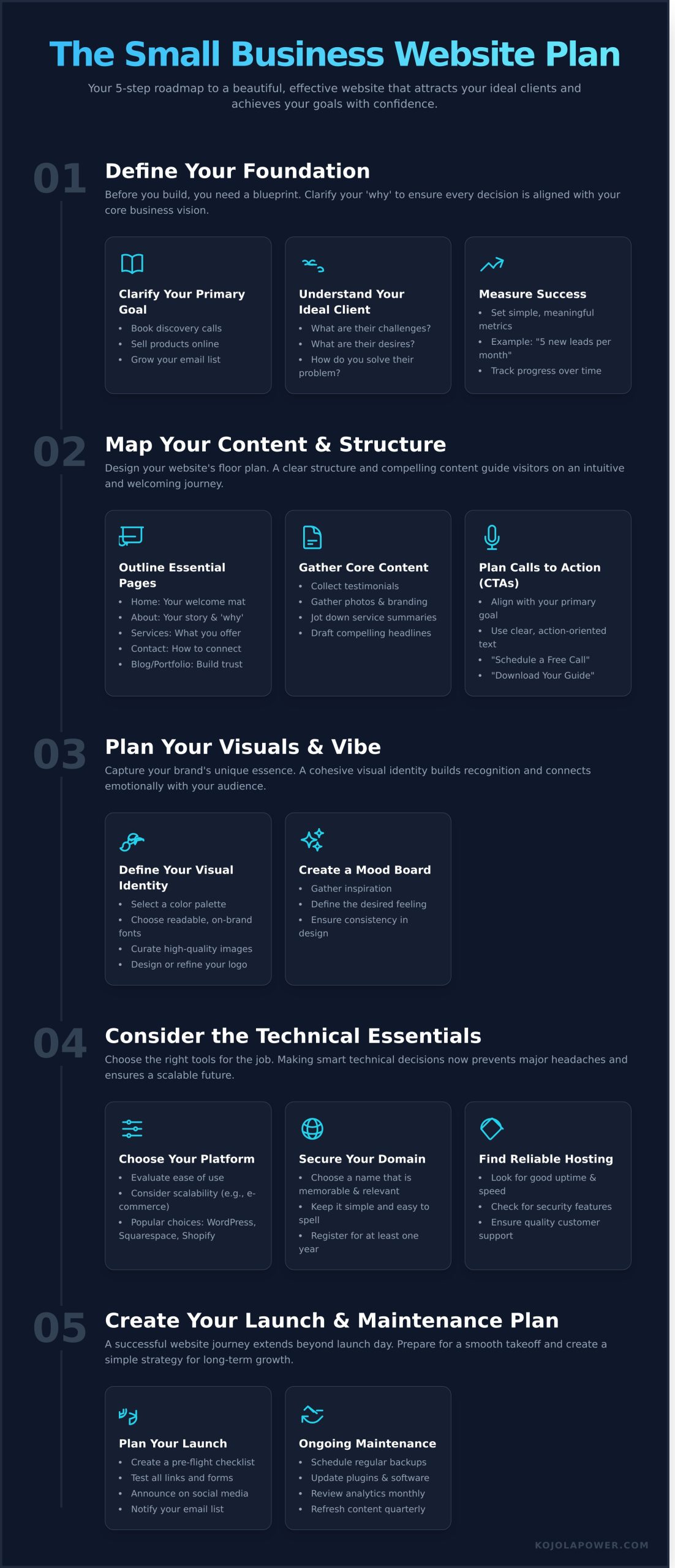
Step 3: Plan Your Visuals & Vibe – Capturing Your Brand’s Essence
Your website’s design is so much more than a collection of colors and fonts. It’s the feeling someone gets when they first arrive-an immediate, intuitive sense of who you are and what you care about. This is where we translate your brand’s unique personality into a beautiful and authentic visual experience. While the technical nuts and bolts are an important part of any digital presence, as covered in resources like Oklahoma State University’s Website Basics for Small Businesses, it’s the heart and soul of your design that builds trust before a visitor reads a single word. A thoughtful visual strategy is a non-negotiable part of a successful small business website plan.
Defining Your Brand’s Personality
Before we can choose a single color, we need to understand the feeling we want to create. How do you want visitors to feel when they land on your site? Calm? Energized? Inspired? Let’s capture that vibe. Take a moment and list 3-5 words that describe your brand’s essence. For example:
- Warm, organic, and thoughtful
- Bold, modern, and professional
- Playful, creative, and vibrant
This simple exercise ensures your website feels like you, not a generic template. This ‘vibe’ becomes our compass, guiding every visual choice we make together.
Gathering Visual Inspiration
Now for the fun part! Find 2-3 websites you absolutely love, even if they’re in a completely different industry. Instead of just saying “I like this,” try to pinpoint what specifically draws you in. Is it the clean, simple layout? The earthy color palette? The beautiful photography? Create a simple mood board on Pinterest or in a folder with screenshots. This becomes a powerful tool in your small business website plan, giving you or your designer a clear visual direction to follow.
Sourcing Your Photography and Imagery
Images do the heavy lifting in telling your story and reflecting your brand’s personality. While high-quality stock photography or illustrations can work, nothing connects with an audience like authentic photos of you, your team, and your work. These images build instant trust and invite people into your world. Whichever path you choose, ensure every image is high-quality and shares a consistent style and tone. Your photos aren’t just decoration; they are a core part of your brand’s voice.
Step 4: Consider the Technical Essentials – Platform, Domain, and Hosting
Let’s gently pull back the curtain on the technical side of your website. I know words like “domain” and “hosting” can feel intimidating, but I promise we can make sense of them together. Think of these pieces as the foundation of your beautiful online home: your address, your plot of land, and the engine that keeps it all running. Making these thoughtful choices now is a crucial part of your small business website plan, and it prevents so many headaches down the road. This is all about empowering you to make choices that feel right for your vision.
Choosing a Memorable Domain Name
Your domain name is your unique, memorable address on the internet (like yourbusiness.com). It’s how your future clients will find and remember you, so it’s worth spending a little time to find the perfect one. Your goal is to find a name that is:
- Short and Simple: Easy for people to type from memory.
- Easy to Spell: Avoid confusing words or alternative spellings.
- Relevant: Clearly connected to your business name or what you do.
For example, a name like Cabinet Refinishing Boulder is highly effective because it clearly communicates the service and location, making it easy for local customers to find and remember.
Try to avoid using hyphens and numbers if you can, as they are often forgotten. Once you have a few ideas, you can check their availability and purchase your domain from a registrar like Google Domains or Namecheap.
DIY Platform vs. Working With a Pro
This is a core decision in your creative journey. DIY builders like Squarespace or Wix can be a great starting point for simple, template-based sites with basic functionality. However, if you dream of a website that can truly grow and evolve with you, WordPress offers limitless flexibility and true ownership. It’s the most powerful and scalable platform, allowing you to add any feature you can imagine, from e-commerce to membership areas. It gives you complete control to create a digital home that truly captures your brand’s essence. When you partner with a professional, you can unlock the full potential of WordPress and co-create a website tailored perfectly to your goals.
Understanding Website Hosting
If your domain is the address, think of hosting as the plot of land where your website lives. It’s the service that stores all your website’s files and makes your site available to visitors 24/7. The quality of your hosting directly impacts your site’s speed and security-two things that are essential for a positive user experience and for search engines like Google. While there are many options out there, a good designer will always recommend reliable, secure hosting. This is often a detail we handle for our clients, letting you focus on your business, not the technical backend.
Step 5: Create Your Launch & Maintenance Plan
Reaching the end of your website design journey is such an exciting moment! But the day your site goes live isn’t the finish line-it’s the starting line for a new chapter. The final piece of your small business website plan is to think about what happens next. Planning for launch day and beyond ensures your beautiful new website continues to be a healthy, growing asset that truly reflects the essence of your business.
Building a Simple Pre-Launch Checklist
Before you share your new online home with the world, it’s wise to do one last, thoughtful walkthrough. This final check ensures every visitor has a seamless and beautiful experience from their very first click. It’s a small act of care that makes a big difference.
- Test everything: Click on every link, fill out every contact form, and test every button to make sure they work as expected.
- Proofread with fresh eyes: Read every single page aloud to catch any lingering typos or grammatical errors.
- Check all devices: See how your site looks and feels on a smartphone, a tablet, and a desktop computer.
- Connect your analytics: Ensure Google Analytics or another tracking tool is properly installed so you can begin to understand your visitors.
Planning Your Post-Launch Promotion
Your website launch isn’t just a technical task; it’s a wonderful marketing event and a reason to celebrate! This is your chance to reconnect with your community and invite them into your new space. Think about how you’ll announce the big news. Plan a heartfelt email to your subscribers and create some beautiful posts for your social media channels. Don’t forget to update your email signature and social profiles with your new website URL!
Thinking About Ongoing Maintenance
Just like a garden, your website needs regular care to stay healthy, secure, and vibrant. A complete small business website plan always includes a strategy for this ongoing nurture. This involves performing regular software updates, running security scans, and refreshing your content. You can decide to handle this yourself, or you can partner with someone to manage it for you, giving you more time to focus on your work. Feeling overwhelmed? A creative partner can guide you through this.
Your Website Journey Starts with a Thoughtful Plan
Building a website that truly feels like you doesn’t happen by accident; it begins with intention. By defining your core goals and mapping out your content and structure, you create a powerful foundation. A thoughtful small business website plan is the most empowering first step you can take, turning a potentially overwhelming project into a creative and purposeful journey.
But a plan is just the beginning. The real magic happens when you bring that vision to life. If you’re looking for a partner to guide you, I offer a collaborative, co-creative process designed to do just that. As an experienced designer and coach, my goal is to help you create a final website that not only works beautifully but also captures your unique essence.
Ready to turn your plan into a beautiful reality? Let’s chat.
Frequently Asked Questions
How long should the website planning process take?
This is such a great question, and the honest answer is that it’s different for everyone. I encourage you to think of it not as a race, but as a thoughtful journey. Generally, setting aside two to four weeks allows you enough unhurried time to really explore your vision, gather inspiration, and define your goals. This gentle pace ensures we can co-create something that truly feels authentic to you and your business, without any sense of rush or pressure.
Do I really need a detailed plan for a simple one-page website?
Yes, absolutely! Even for a beautiful one-page site, a plan is our creative map. It helps us get crystal clear on the single most important story you want to tell and the one action you want visitors to take. Think of it less as a rigid blueprint and more as a way to mindfully create a simple, powerful, and intuitive experience that captures the true essence of your brand. A little intention upfront makes all the difference.
What is the most common mistake small businesses make when planning a website?
A very common hurdle I see is trying to be everything to everyone. It’s so easy to get caught up in adding every feature you’ve ever seen on other sites. The most beautiful and effective websites, however, have a clear, heartfelt focus. They know who they are for and what they want to communicate. My advice is to always return to your ‘why’-the core purpose of your business. This will be your compass for every decision we make together.
Can I change my plan after I’ve started building the website?
Of course! The creative process is a journey, not a rigid path. Our plan gives us a wonderful direction, but new ideas and inspirations can surface once we start bringing your vision to life. We’ll build in check-in points to make sure everything still feels right to you. While big changes might affect our timeline, small, intuitive adjustments are a natural part of co-creating a website that truly feels like an extension of you. It’s a living project.
What’s a realistic budget to keep in mind during the planning phase?
Thinking about your budget is a key part of any good small business website plan. It’s helpful to view it as an investment in your digital home. For a custom, professionally designed website that truly captures your essence, budgets typically start around a few thousand dollars and go up from there depending on your specific needs. This investment covers the collaborative design journey, expert build, and ensuring your new online space is both beautiful and effective for your unique business goals.
Should I write my own content or hire a copywriter?
This is a deeply personal choice. Writing your own content can be a wonderful way to pour your heart into the site and ensure your authentic voice shines through. However, it can also feel overwhelming! A professional copywriter can be an amazing partner in this process. They are skilled at listening to your story and helping you find the clearest, most compelling words to express it. I can connect you with some wonderful writers I trust if that support would be helpful.